
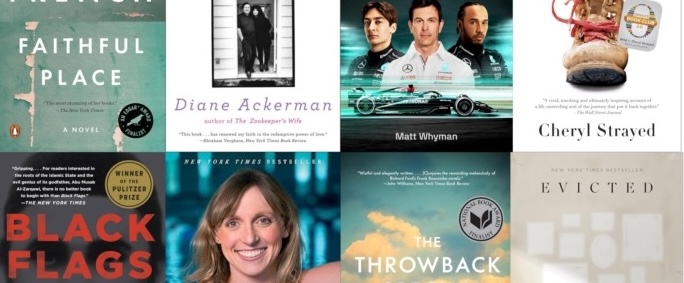
2025 was something of a mixed bag for me in terms of reading. While I read some excellent nonfiction books, I only found two novels that I liked enough to award five stars to in Goodreads. On the nonfiction side, I five-starred six books.
I did manage to reach my expanded retirement-era reading goals: My previous goal was 25 books and 100 short stories, but last year I upped it to 31 books and 100 stories. I ended up reading 31 books and 112 short stories. (There is admittedly some double-counting going on there, because of those 31 books, five were short story collections.) For 2026, I’ll shoot for 31 books and 120 stories.
So here are my eight favorite reads from the year, along with my capsule reviews from Goodreads. Note, none of these were actually published in 2025; I just happened to read them last year. They’re presented here in the order that I read them, separated by category.
Nonfiction
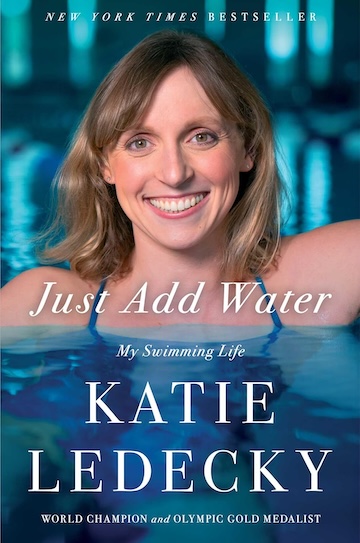
Just Add Water: My Swimming Life
By Katie Ledecky
Katie Ledecky, of course, is arguably one of the most dominant swimmers in the history of the sport. She has now won the 800 freestyle in four consecutive Olympic Games, with countless World Championships distance freestyle victories in between the Olympics. She is the only person to have won the Olympic women’s 1,500 free, as that distance has only been swum in the last two games, at Tokyo and Paris.
I used to be a competitive swimmer (and I’m currently a recreational one), so I could be a little biased here, but I loved this book. This memoir of Ledecky’s swimming life is told with humility and honesty, and it brought back a lot of memories of what it’s like to grow up as a swimmer. I think the behind-the-scenes look at competing in the Olympics and other high-level events will be of interest to every sports fan.
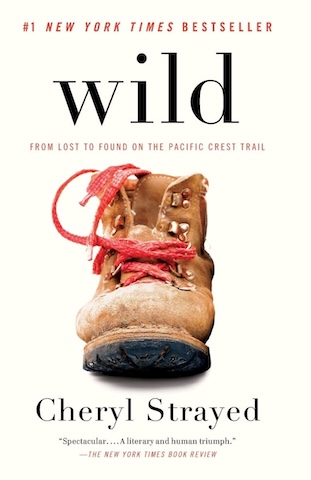
Wild: From Lost to Found on the Pacific Crest Trail
By Cheryl Strayed
This book has been on my to-read list since it came out in 2012 and several friends read it. Most people probably know the story; a woman reeling from her divorce and the death of her mother decides to go “find herself” while hiking the Pacific Crest Trail from the Mojave Desert in California to the Columbia River in Oregon. Many people have also, no doubt, seen the movie based on the book, which came out in 2014. I’ve seen parts of the movie but not the whole thing, start to finish, and doing so did not hamper my enjoyment of the book one bit. This is a terrific story, well written and perfectly paced. Both the book and the movie feature numerous flashbacks to her life before the PCT hike; this can be difficult to pull off, but Strayed did a great job of balancing the history with the story of the hike. Really enjoyable read.
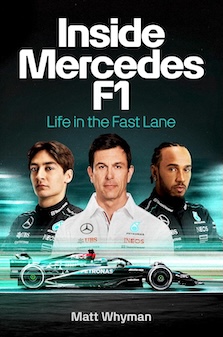
Inside Mercedes F1: Life in the Fast Lane
By Matt Whyman
I’ve been a fan of Formula 1 racing for several decades, and a big fan of Lewis Hamilton’s since he joined the circuit in 2007. Hamilton rewrote the record books while racing for the Mercedes F1 team, so when I saw this book I jumped at it.
The book follows the team for 18 months, from the start of the 2023 season to halfway through the 2024 season, and it delves into every aspect of the Mercedes F1 operation. Hint, the folks who are at the track on race weekends are only a small part of the team. The author had universal access both to the entire race-weekend operation and Mercedes F1’s two factories, in Brackley and Brixworth, England, and devoted major sections to the team’s state-of-the art simulator, wind tunnel, the traveling team headquarters that is assembled and disassembled each race weekend, and the engineering team that is designing the next year’s car during the current season. Not to mention the public face of the team, drivers Lewis Hamilton and George Russel and team principal Toto Wolff. In all, there are are hundreds of highly skilled people working to squeeze every bit of pace out of the car that they can, knowing that every other team is doing the same.
Forget Netflix’s “Drive To Survive,” which has become more of a cliche (or even worse, a joke) each season. This is the real deal, and it’s fascinating for an F1 fan. I think it would even be interesting to a non-fan, but I understand that there’s not really a reason for a non-fan to pick the book up in the first place.
It’s true that the author was given exceptional access, and the resulting book paints the team in a positive light. It doesn’t take a genius to recognize that those two facts are related. But the author avoids fawning and I think the portrait he paints is accurate, and the book gives us a look at a lot of behind-the-scenes activity that we might never know about otherwise.
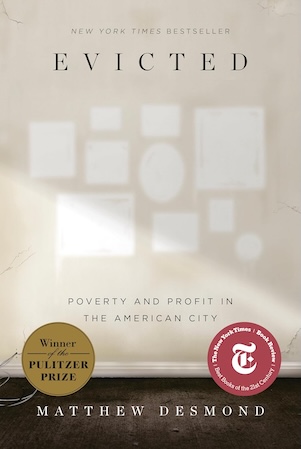
Evicted: Poverty and Profit in the American City
By Matthew Desmond
I don’t often say things like this, but Evicted is a book that probably everyone should read. It’s a very intimate look at the housing crisis for low-income people in America’s cities, in this case Milwaukee. More specifically, the book looks at the long-term effects of evictions on both the people being evicted and on society as a whole.
I say intimate because the author, Matthew Desmond, actually spent months living among people who were fighting—and often failing—to remain in their homes. Much of the book includes dialogue, in quotation marks, as families and landlords go through the eviction process; as I was reading it, I wondered how Desmond would be able to capture that dialogue without being there at those critical moments. But as he explains in an afterword and epilogue, he actually was there, right in the middle of the action.
The stories of people grasping to just keep up with their rent payments each month, let alone buy food, are depressing but gripping, and if you do read this book, it will stay with you for a long time.
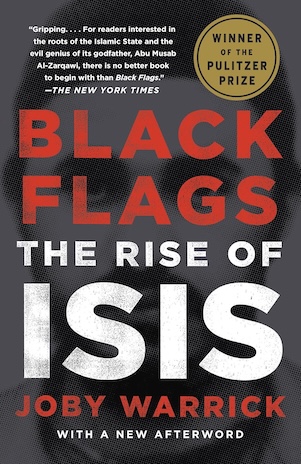
Black Flags: The Rise of ISIS
By Joby Warrick
This book won the Pulitzer Prize for General Nonfiction in 2016, earning itself a spot on my Books From The Teens reading list. To be honest, it wasn’t one that I was particularly looking forward to; I expected to get lost in a sea of Arabic names, for one thing. And obviously, the subject matter isn’t exactly uplifting. In fact, though, I really enjoyed the book. It focused on a surprisingly small number of players, so it wasn’t difficult to keep track of who was who. Two things were made clear: 1), the invasion and overthrow of Iraq in 2003 was a massive mistake that the world will be paying for for decades, if not generations; and 2) it’s extremely difficult for any one country or leader to take on the problem of radical Islam and international terrorism. Even if the whole free world works together, it’s going to be tough if there are nations that sponsor terrorist organizations. Anyway, the book was a great lesson in recent history and worth that Pulitzer, I’d say.
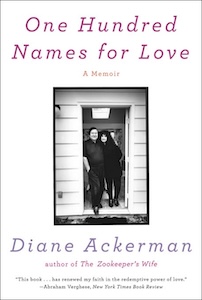
One Hundred Names for Love: A Memoir
By Diane Ackerman
This is a fascinating memoir of stroke recovery. The author’s husband suffered a stroke while hospitalized for diabetes, leaving him with severe aphasia and other issues. He was also an author, poet and professor, and together they had built a life around words and wordplay. It was all lost with the stroke, but they set to work to rebuild his language abilities. The book could have been maudlin, but it is instead filled with optimism and humor, with a bit of brain science added in. A good read, particularly if you are a word nerd—which I’m not, really, but I enjoyed it.
Fiction
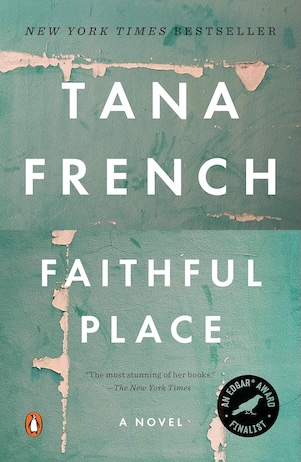
Faithful Place
By Tana French
This is the third book in Tana French’s Dublin Murder Squad series, also the third from the series I’ve read. And I’m definitely going to read all six. I would call them sort of hybrids of the police procedural/psychological drama/murder mystery genres, but mainly what they are are highly character-driven stories that make you feel like you’re right there in Dublin. French is a fantastic writer and I’ve thoroughly enjoyed the three books I’ve read so far—even book 2 in the series, which had a completely outlandish premise but she made it work.
In this story, detective Francis Mackey—who works in undercover, not murder—has been estranged from his family for 20 years until the discovery of a long-lost suitcase in one of his teenage hangouts reels him back in. All of the characters and family dynamics are richly drawn and the story plays out to a satisfying conclusion. Five stars without reservation.
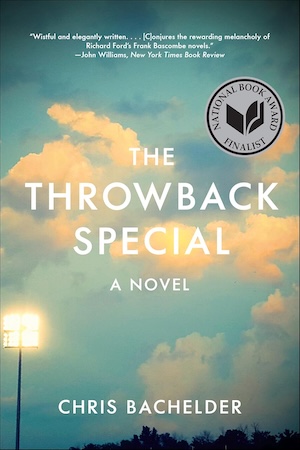
The Throwback Special
By Chris Bachelder
The premise behind this novel is that there’s a group of 22 men who get together each year on the anniversary of the infamous Monday Night Football play in which Joe Theismann had his leg destroyed in a tackle by Lawrence Taylor. The men reenact the play, holding a lottery beforehand to see who will play each of the positions, offense and defense. It’s a strange idea, and a strange book because it’s super-omniscient: the reader gets into the mind of all 22 of the characters, plus a few others in the hotel where they meet. For the first third or so of the book it was a little overwhelming to keep track of everybody; it felt like steroidal ADHD. But then I gradually got more comfortable with the chaos and started to really enjoy the book.
Into The New Year
I started 2026 with a book that—at least based on the first one-third of its pages—appears destined for this list a year from now. The Dead Hand by David E. Hoffman is a fascinating account of the last years of the Cold War and the first few years after the fall of the Soviet Union.
If you’re so inclined, you can follow along with my reading during the year by clicking on the READING tab at the top of this page or following me on Goodreads. As always, happy reading!
